

Steve Jobs, the late founder of Apple, once quipped that “simplicity is the ultimate sophistication”, a belief that has led Apple to become the largest listed company in the world.
This belief is nothing new; in Aesop’s Fable “The Fox and the Cat”, the fox boasts of hundreds of ways of escaping while the cat has just one. When both hear the hounds approaching, the cat uses its one escape to climb up a tree to safety, while the fox was confused and caught by the hounds.
Like the fox, analysis paralysis, where overthinking a situation can cause confusion and indecision, affects everyone at some point. For many, however, mental paralysis can be so great and frequent that it seriously impairs their everyday functioning.
The line between regular procrastination and extreme decision paralysis is hard to distinguish but is thought to be due to other co-occurring conditions, especially ADHD. Hence the term ADHD paralysis which, although not officially recognized as either a separate disorder nor a symptom of ADHD, still affects a significant proportion of people.
This article aims to clear the fog on this sometimes cloudy and confusing subject, using the latest neurological and psychological research to investigate its symptoms, causes, relationship to other disorders, and ultimately, ways to treat it.
So if you’re stuck in bed, desperately seeking ways to overcome your analysis paralysis, fear not; the first step is always the hardest, and there is no better first step than reading this article.
What is Analysis Paralysis?
Analysis paralysis, sometimes called paralysis by analysis or task paralysis, describes a process (individually or as a group) where overanalyzing a situation results in a lack of ability to make a decision. You are metaphorically frozen in indecision, meaning that no solution or course of action is decided upon within an appropriate time frame.
The driving force behind analysis paralysis is overwhelm, where many options and a lot of information, combined with the fear of failure or making the wrong decision, effectively shuts down your decision-making faculties.
Those who are newly promoted often report falling victim to analysis paralysis, as the increased responsibility but lack of experience send their emotions into overdrive. The lack of experience means they are in unprecedented territory, and the fear of making a poor decision in front of their boss who recently promoted them means they feel safer making no decision than risking a wrong one.
What is ADHD Paralysis?
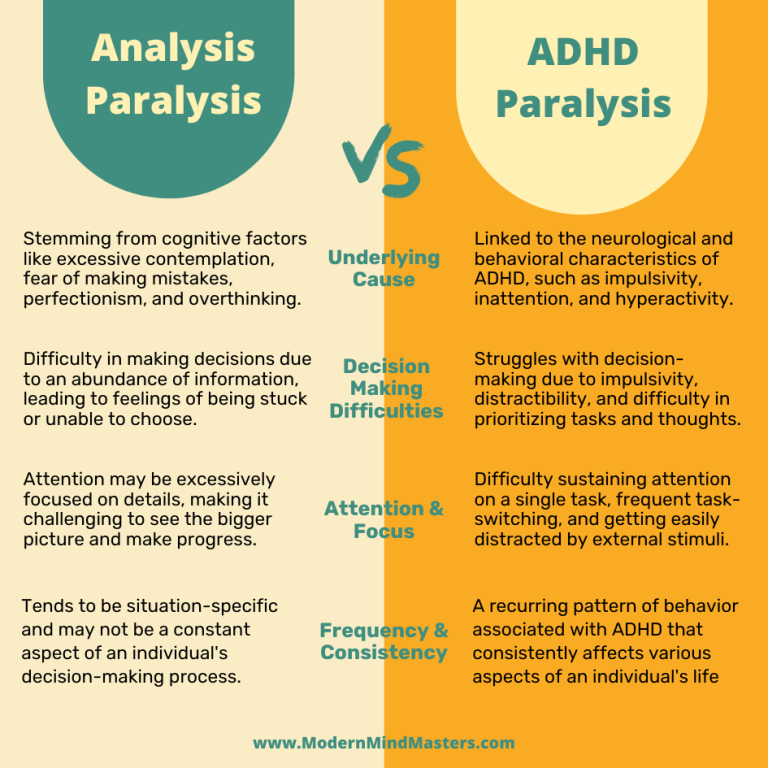
ADHD (Attention Deficit Hyperactivity Disorder) paralysis is related to the symptoms experienced by individuals with ADHD, where they often have difficulty sustaining attention, focusing on tasks, organizing activities, and following through on plans.
As a result, individuals experiencing ADHD paralysis often find themselves stuck or paralyzed in the face of multiple tasks or responsibilities. Rather than overanalyzing like in analysis paralysis, ADHD paralysis is more related to difficulties initiating and maintaining activities due to attention and impulsivity challenges.
ADHD paralysis is not a recognized clinical term (nor an official symptom of ADHD according to the latest DSM-5), but it can be a useful way to colloquially describe certain challenges faced by individuals with ADHD.
Paralysis can manifest in ADHD individuals in many ways, but three of the most observed are an overload in thoughts, emotions, sensory overload (mental paralysis), an overload in choices and information (choice paralysis), and an overload in emotions regarding outcomes for a decision (task paralysis).
What are the Symptoms of Analysis Paralysis?
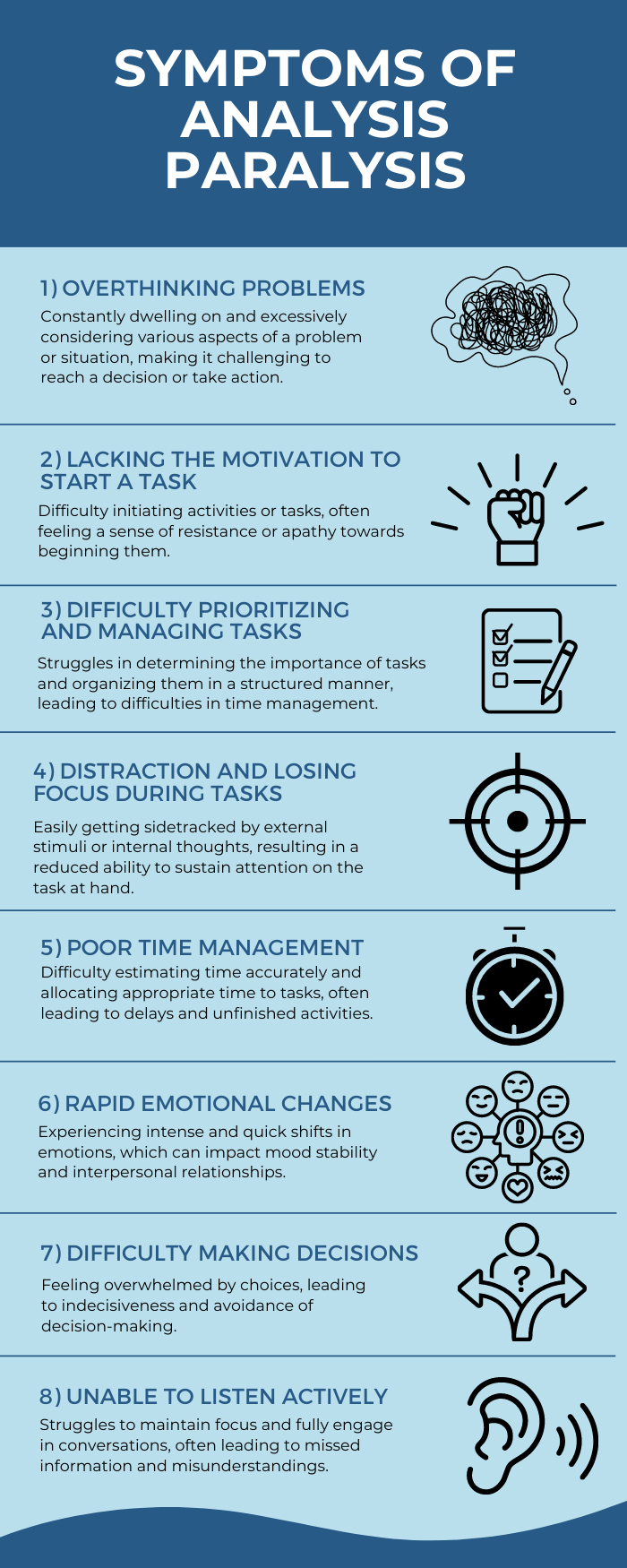
Research into task paralysis, especially of the ADHD variant, is pretty slim. As a result, there is no concrete set of symptoms that define a person with task paralysis or ADHD paralysis. But of the many anecdotal examples from those who report feelings of decision paralysis, the following symptoms are commonly cited:
- Overthinking or overanalyzing problems
- Lacking the motivation to start a task
- difficulty prioritizing and managing tasks
- Distraction and losing focus during tasks
- Poor time management
- Rapid mood and emotional changes
- Difficulty making decisions
- Unable to listen actively
- Jumping between tasks
- Lack of clarity (brain fog)
The number and intensity of symptoms felt are highly variable based on individual circumstances. To make matters more confusing, many of these symptoms are also indicative of ADHD, hence the relationship between task paralysis and other disorders such as ADHD and other anxiety and mood disorders.
What Causes Analysis Paralysis?
Like ADHD, analysis paralysis is thought to be largely a result of challenges to executive functioning, a set of cognitive processes responsible for managing and regulating various mental activities to achieve goals effectively.
When executive functions are compromised, individuals may find it more difficult to navigate the abundance of information and options, leading to prolonged analysis and decision-making difficulties.
Psychologically, it seems perfectionism and emotional dysregulation (which often manifests as rejection sensitivity in those with ADHD) may be two of the largest contributing factors in task paralysis, for those with or without ADHD.
ADHD Paralysis and Perfectionism
Most people are happy to simply try their best. After all, that is all we can be expected to do, and even if we fail, we succeeded in trying the best we can, and logically there is no shame in that.
For a perfectionist, however, their best is not enough. They follow the Yoda school of thought, where they must “do or do not, there is no try”. While admirable in theory, in the real world of unknowns and imperfect information, perfectionism is not only near impossible, it’s also highly inefficient.
Ultimately, the need for perfectionism leads to procrastination, as the anxiety that a potentially larger problem may arise or the misguided belief that a superior solution is just a short way away, stalls any form of progress.
In individuals with ADHD, perfectionism, and procrastination may make the effect of ADHD paralysis even worse. This study investigated the link between ADHD and excessive procrastination, testing 54 prescreened students who completed self-report questionnaires while also observed solving math problems.
The study found that inattention (a common symptom of ADHD) was positively correlated with general procrastination, suggesting that students with higher levels of inattention were more likely to procrastinate in everyday tasks. Symptoms of hyperactivity and impulsivity, two other symptoms of ADHD, were not significantly related to procrastination, however.
The result was a mixed bag, suggesting that inattention is specifically associated with general procrastination, but not other ADHD symptoms such as impulsivity. As a result, further research is needed to clarify the effect of ADHD on procrastination and task paralysis.
ADHD Paralysis and Emotional Dysregulation (Rejection Sensitivity)
Rejection sensitivity, a heightened emotional sensitivity to the possibility of rejection or negative evaluation from others, is commonly associated with ADHD and may be another contributing factor to ADHD paralysis.
Emotions are the driving factor behind most decisions, whether conscious or subconscious, so it is no surprise that those who exhibit emotional dysregulation, such as those with rejection sensitivity and ADHD, also tend to suffer from task paralysis.
Rejection sensitivity can contribute to or exacerbate analysis paralysis in the following ways:
- Fear of making mistakes: Rejection-sensitive individuals often fear making mistakes or being judged negatively by others, leading to excessive overthinking and hesitation when faced with decisions, as they worry about potential negative outcomes and rejection resulting from their choices.
- Seeking approval: People with rejection sensitivity may have an excessive need for validation from others, causing them to question their decisions or options, as they constantly seek reassurance that their choices will not lead to rejection.
- Overthinking consequences: Rejection-sensitive individuals may be more prone to overthinking the potential consequences of their decisions, imagining worst-case scenarios, and getting stuck in a loop of analyzing every possible outcome. This overthinking can paralyze them into inaction, as they try to find the “perfect” choice to avoid any potential rejection.
- Difficulty handling criticism: Rejection sensitivity can make it challenging to constructively deal with criticism or feedback. Instead of using criticism as a learning opportunity, individuals may take it as a personal attack, further reinforcing their fear of rejection.
- Avoidance of decision-making situations: Rejection-sensitive individuals may unconsciously avoid situations that involve making choices or decisions, as these situations can trigger their fear of rejection. By avoiding decision-making, they inadvertently fall into analysis paralysis, unable to move forward in their lives due to the lack of action.
How to Overcome ADHD/Task Paralysis
Fortunately, there is a glimmer of hope; executive functioning skills can be improved through practice, strategies, and support, even for those whose task paralysis may stem from medical disorders such as ADHD.
Ultimately, most symptoms stem from the same root cause, overwhelm. Whether overwhelmed by emotions or too much information, the need for a perfect solution will lead to an overworked and frustrated brain.
Our aim, therefore, is to clear the fog of confusion and rebalance the scale between known and unknowns, which the following tasks all focus on.
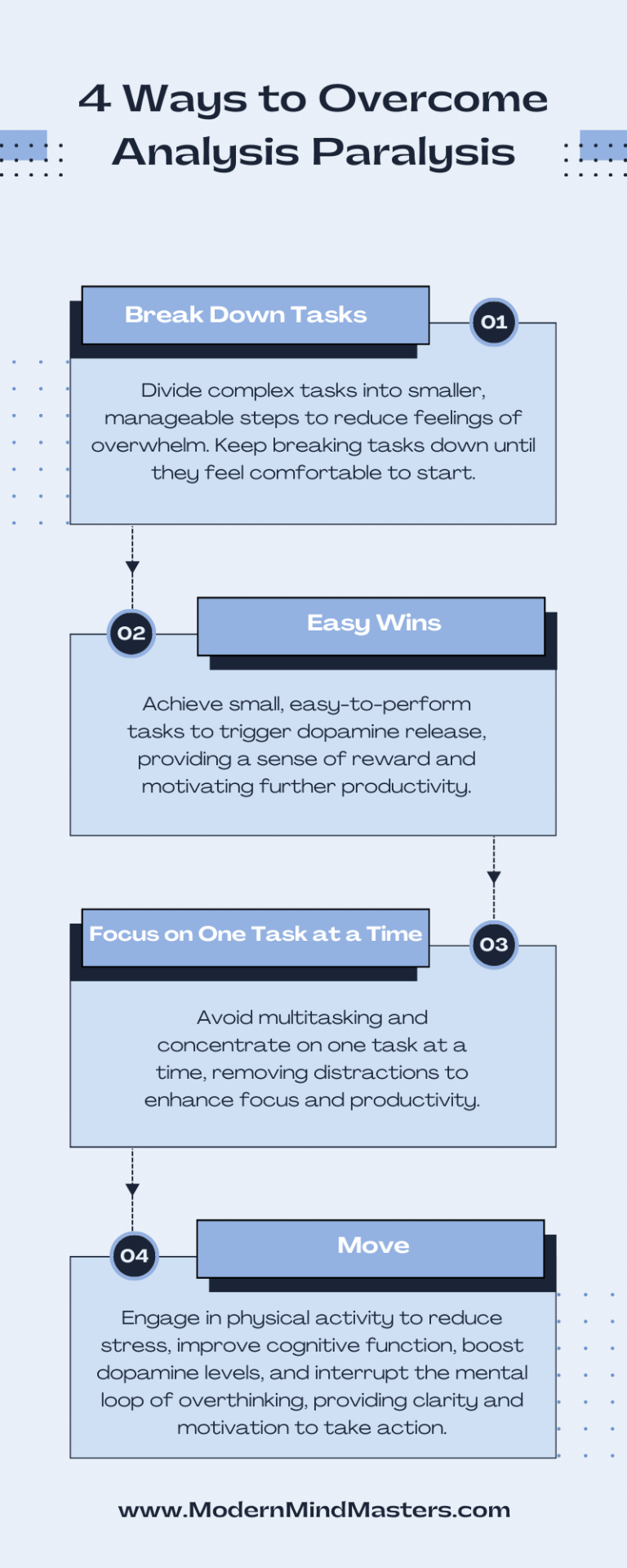
1) Break Down Tasks from Unknowns to Knowns
Having worked as a construction manager for ten years, completing complex projects, such as million-dollar bridge erections to billion-dollar nuclear facilities, would be impossible for even the most intelligent engineers without breaking down each task into small enough pieces where resources and costs can be applied to each step.
We should take the same approach to our daily tasks, where we break large tasks, such as completing an essay, into smaller ones, such as assembling the introduction, main body, and conclusion. Three smaller tasks are more manageable than one larger one, helping to minimize the willpower and motivation needed to make the first step (which, remember, is the hardest one).
The idea is to keep breaking your tasks down until the point where they no longer feel overwhelming, which will differ for each individual. For some, writing the introduction may still seem overwhelming (where do you start?), so break them down further, and further, until you feel comfortable making the first step. For some, this may be as simple as performing an internet search and reading one article.
Productive people do this naturally, not because they have a greater mental capacity, nor because they are genetically more productive, but simply because they have more practice implementing this naturally into their daily lives.
2) Easy Wins
The brain loves a win, no matter how small. For some, the simple act of cleaning their desk facilitates a spike of dopamine, a neurotransmitter in the brain that plays a crucial role in reward-motivated behavior and pleasure sensations.
Easy wins, achieved by completing small and easy-to-perform tasks, release dopamine that provides a sense of reward, allowing us to ride the natural wave of chemical highs and drive us toward further productivity and success.
If you feel in a rut or unable to start or finish an activity, spend a few minutes setting yourself a small (but still important) task that can be completed relatively easily. Whether the simple act of cleaning your desk in preparation for work or hitting the gym, each small win can get the dopamine ball rolling, and you can ride the momentum to further accomplishment.
3) Focus on One Task at a Time
The brain is not good at flicking from one task to another quickly, one reason why social media, which shows us near unlimited information very quickly, can rapidly lead to procrastination.
Pick one task, preferably the most important one, and remove all other distractions that may interrupt it. Muster all your mental energy to finish this first task before moving on to others.
Starting is always the hardest part, so our aim should be to make the first step as easy as possible.
4) Move
When all else fails, and the urge to procrastinate overcomes all other senses, the simple act of moving can provide enough energy to jump-start your willpower.
We all know exercise is vitally important, but most still underestimate the powers of even a little vigorous movement. Some key benefits include:
- Stress reduction: Physical activity has been shown to reduce stress and anxiety, which are often associated with analysis paralysis. By reducing these negative emotions, and stress hormones such as cortisol, exercise can create a more positive mindset and clearer thinking.
- Enhanced cognitive function: Exercise increases blood flow to the brain, which can improve cognitive function, including decision-making abilities. It can lead to better focus, increased creativity, and the ability to approach problems from different angles.
- Boosting dopamine levels: Exercise releases dopamine, the “feel-good” neurotransmitter, which can elevate mood and provide a sense of reward. This increase in dopamine can motivate individuals to break through their analysis paralysis and take action.
- Breaking the pattern: Engaging in physical activity interrupts the mental loop of overthinking and rumination, providing a mental break from the decision-making process. This break can lead to greater clarity and perspective when returning to the problem.
If nothing else, the simple act of moving reminds both your body and brain that you are not actually paralyzed. Whether lifting an arm or wiggling your toes, movement reinforces the fact that your body and mind are under your control.
Remember, the first step is always the hardest, so we are looking for whatever way we can to induce movement and activity. If that starts with simply wiggling your toes, then so be it. Like a snowball rolling down a hill, getting it started is the hardest part, after which gravity and momentum will do the rest.
Treatments for ADHD Paralysis
The tools above are appropriate for general analysis paralysis, which anyone can utilize to overcome their procrastination.
For those with ADHD, however, this paralysis may be harder to overcome. Again, the link between ADHD and paralysis is not concrete, but research has suggested that task paralysis can be worsened by ADHD.
If a qualified and professional medical person has diagnosed your paralysis as an offshoot of ADHD, ADHD treatments may work for you. Treatments may include prescription medication (of which the most common are dopamine stimulants such as Ritalin and Adderall), therapy, such as cognitive behavioral therapy (CBT), and dispositional mindfulness therapy, which research has shown to be beneficial in reducing ADHD-related symptoms.
You can find out more about ADHD treatments in this article here. As always, make sure you consult a qualified medical professional before attempting any treatment for ADHD.
Conclusion
Analysis paralysis, where we overthink to the point it hinders decision-making, affects individuals from all walks of life. But for some, especially those with ADHD, it can be debilitating, hindering everyday functioning.
While not officially recognized, the concept of ADHD paralysis, associated with attention and impulsivity challenges, sheds light on the potential link between ADHD and task paralysis.
The symptoms of analysis paralysis, such as overthinking, lack of motivation, and poor time management, can be overwhelming and closely related to the challenges faced by individuals with ADHD. Perfectionism and emotional dysregulation, particularly rejection sensitivity, further compound the problem, making it harder to overcome this state of mental paralysis.
There is hope, however. By understanding the neurological and psychological factors contributing to analysis paralysis, we can develop strategies to break through this state of indecision.
By breaking down tasks into manageable steps, celebrating easy wins, focusing on one task at a time, and incorporating movement and exercise, we can unlock our decision-making potential and ride the wave of dopamine-induced motivation. For those with ADHD-related paralysis, treatments like medication, therapy, and mindfulness can provide valuable support if deemed suitable by a medical professional.
In the end, the key lies in simplification. As Aesop’s fable reminds us, it is “better to have one safe way than a hundred uncertain paths”. By finding clarity and taking the first step, we can navigate through the fog of analysis paralysis and move towards more decisive and fulfilling lives.
FAQs
What is ADHD paralysis and why does it happen?
ADHD paralysis describes feeling mentally “stuck” or unable to start tasks due to overwhelm, attention challenges, or emotional overload. It’s not an official diagnosis but a common experience for people with ADHD, especially when executive function and motivation are pushed past capacity.
How is ADHD paralysis different from analysis paralysis?
Analysis paralysis comes from overthinking and trying to make the perfect decision. ADHD paralysis is more about difficulty initiating tasks, staying organized, or managing emotions. Both can feel similar, but ADHD paralysis is rooted in attention and executive-function challenges rather than overanalysis alone.
How can I overcome ADHD paralysis or task paralysis?
Break tasks into smaller steps, aim for quick “easy wins,” remove distractions, and use movement to reset your brain. These reduce overwhelm and help restart action. For those with diagnosed ADHD, treatment options like medication or cognitive-behavioral therapy may also help.